
PUC Certificate: Check & Download Online
A valid Pollution Under Control (PUC) certificate is mandatory for every vehicle in India. Here’s how to check and download yours from the Parivahan portal, how long it stays valid, what it costs, and the fine for driving without one.
Quick answer
Go to puc.parivahan.gov.in, open PUC Certificate, enter your registration number and the last 5 characters of your chassis number with the captcha, and click PUC Details to view and download it. If it’s expired, you can’t download a new one online, you first get a fresh emission test at any authorised PUC centre, and the new certificate then shows up on the portal.
What a PUC certificate is, and why you need it
It’s proof your vehicle’s emissions are within legal limits, and it’s checked more often than people expect.
Legally mandatory
Every vehicle on the road must carry a valid PUC certificate, petrol, diesel, CNG or otherwise.
Needed for other services
A valid PUC is required for insurance renewal, and for RC services like renewal, transfer and duplicate.
Checked at traffic stops
Traffic police and ANPR systems can flag an expired PUC, and the fine is steep.
Emission proof
It records that your exhaust emissions were tested and found within the prescribed limits on the test date.
Check & download your PUC online
This works when you already have a valid PUC on record and just need a copy.
-
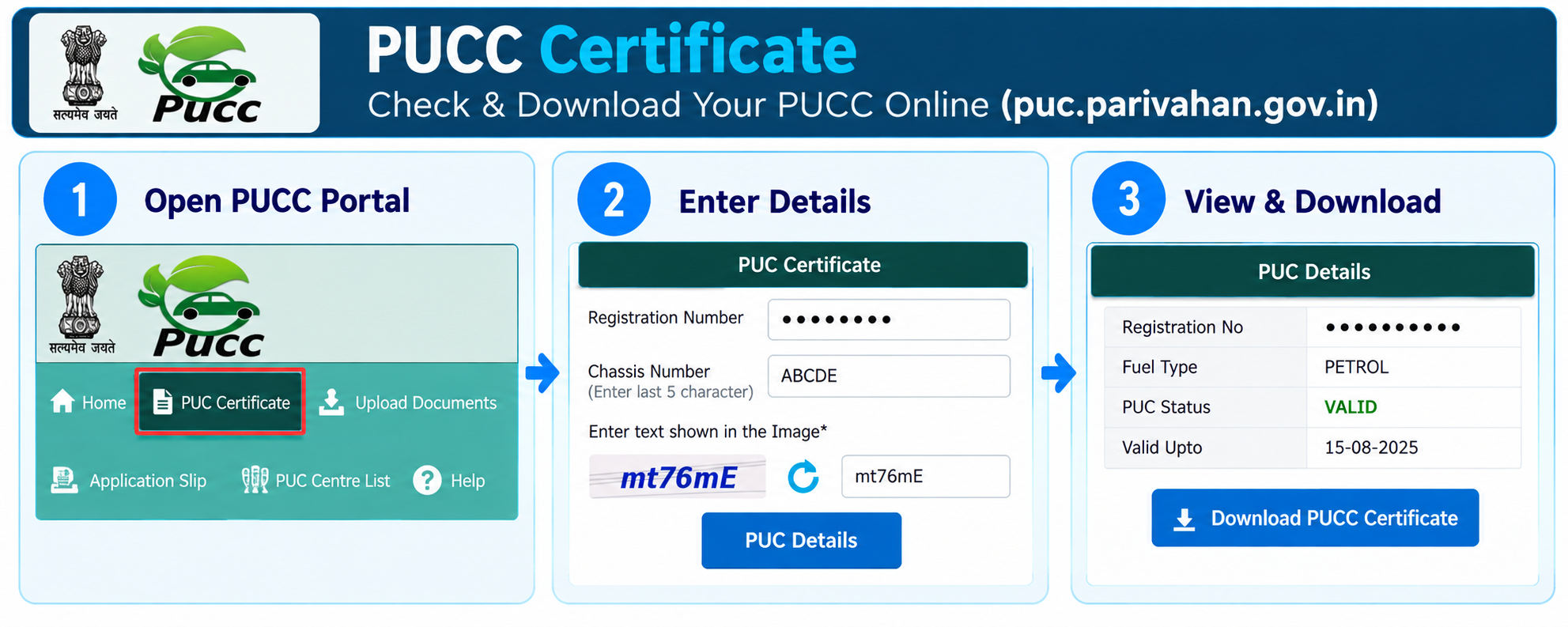
Open the PUC portal
Go to puc.parivahan.gov.in, the official Pollution Under Control portal.
-
Open “PUC Certificate”
Select the PUC Certificate option from the menu.
-
Enter your vehicle details
Fill in your registration number (up to 10 characters) and the last 5 characters of your chassis number, then the captcha shown on screen.
-
Click “PUC Details” and download
Press PUC Details. Your certificate’s status and validity appear, from here you can view, download or print the certificate.
Want to see older certificates too? The portal’s PUC Certificate History option lists your vehicle’s past PUC records, not just the current one.
How long a PUC stays valid
Rule 115(7) of the Central Motor Vehicles Rules sets the validity by the vehicle’s emission standard. The expiry date printed on your certificate is the one to go by.
Brand-new vehicle
A PUC certificate becomes necessary after 1 year from the date the vehicle was first registered.
BS-IV and BS-VI vehicles
After the first year, a PUC certificate is valid for 1 year (12 months).
Older vehicles (below BS-IV)
A PUC certificate is valid for 6 months. Your vehicle’s emission standard is shown in the vehicle details on Vahan.
Renew it before it expires, there’s little or no grace once it lapses, and driving on an expired PUC is a finable offence from day one.
PUC test fees
The test itself is cheap, checking or downloading the certificate online is free. Charges are state-set, so treat these as typical.
| Vehicle type | Typical fee |
|---|---|
| Two-wheeler | ₹50–₹100 |
| Petrol car / four-wheeler | ₹80–₹125 |
| Diesel car / four-wheeler | ₹100–₹150 |
| CNG / LPG vehicle | ₹60–₹100 |
You pay this at the testing centre for the emission test. Viewing or downloading the certificate itself on the Parivahan portal costs nothing.
Getting a fresh PUC (when it’s expired)
You can’t renew a PUC purely online, the emission test has to happen with the vehicle physically present.
-
Find an authorised PUC centre
Most petrol pumps have an authorised PUC testing booth; you’ll see the “Pollution Under Control” board, no appointment is usually needed. To find one for sure, use the PUC Centre List option on the portal, pick your state and office to see the authorised centres near you.
-
Get the emission test done
The operator inserts a probe into your exhaust and the machine reads your emission levels against the limits. It takes just a few minutes.
-
Pay and collect the certificate
If your vehicle passes, pay the fee and get the printed certificate. The record is uploaded to the Parivahan database automatically.
-
Download it online anytime
Once uploaded, you can pull a copy anytime from puc.parivahan.gov.in using the steps above.
If your vehicle fails the test, get it serviced (tuning, air filter, injectors) and re-test, an unfit vehicle can’t be issued a PUC.
What the emission test actually checks
The machine measures different things for petrol and diesel, which is why the two tests look different.
Petrol / CNG / LPG
Measures carbon monoxide (CO %) and hydrocarbons (HC, in ppm) at idle. Both must be within the prescribed limits to pass.
Diesel
Measures smoke density (opacity) using a free-acceleration test, the engine is revved and the smoke meter reads how much light the exhaust blocks.
The limits depend on your vehicle’s Bharat Stage (BS) norm, newer BS-VI vehicles have tighter limits than older ones. The certificate records your actual readings against those limits.
Why vehicles fail, and how to pass
If your vehicle fails, it’s almost always a maintenance issue you can fix, then re-test.
Dirty air filter
A clogged air filter richens the mixture and pushes up CO/HC. Cleaning or replacing it is the cheapest first fix.
Worn spark plugs
Old or fouled plugs cause incomplete combustion and high HC. Replacing them often clears a petrol failure.
Poor tuning / injectors
An out-of-tune carburettor or clogged fuel injectors throw off the air-fuel mix. A basic service usually sorts it.
Old engine oil / general wear
Degraded oil and a long-overdue service raise emissions across the board, get it serviced before re-testing.
Quick pre-test tip: drive the vehicle for a few kilometres first so the engine is warm, a warm engine burns cleaner and is more likely to pass.
Fine for driving without a valid PUC
Under Section 190(2) of the Motor Vehicles Act, driving without a valid PUC can attract a fine of up to ₹10,000 (and, in principle, imprisonment up to 3 months for a first offence). In practice many states charge less on a first offence and more on repeats, but the amount can genuinely reach ₹10,000, so it’s never worth the risk. Our traffic fine finder lists the penalty for this and other offences.
Keeping your PUC valid is far cheaper than the fine, the test costs under ₹150.
Mistakes to avoid
- Assuming a screenshot is enough, keep a proper downloaded/printed copy or the digital one in DigiLocker/mParivahan
- Letting it lapse, there’s little grace, and the fine applies from the expiry date
- Entering the full chassis number when the portal asks only for the last 5 characters, and it must match your RC
- Trying to “renew online” without a test, the emission test must be done physically first
- Using an unauthorised booth, only certificates from authorised centres upload to Parivahan and are valid
Common questions
Can I renew my PUC completely online?
No. The emission test needs the vehicle physically at an authorised centre. Only checking and downloading the certificate is online, the test itself can’t be.
How long is a PUC valid?
For a BS-IV or BS-VI vehicle, a PUC is valid for 1 year. For older vehicles it is valid for 6 months. A new vehicle needs one only after 1 year from its first registration. Always go by the expiry date printed on the certificate.
What does a PUC test cost?
Roughly ₹50–₹100 for a two-wheeler and ₹80–₹150 for a car depending on fuel and state (some states, like Delhi, have revised rates recently). Downloading the certificate online is free.
Is a digital PUC valid?
Yes. A PUC pulled from Parivahan (or shown via DigiLocker/mParivahan) is valid for verification, just like the printed copy.
I can’t find my PUC on the portal, why?
Either it’s expired (get a fresh test), or the details don’t match, recheck the registration number and the last 5 characters of the chassis number against your RC. See our RC status guide to look up your vehicle’s details.
Check your PUC certificate
This takes you to the official Parivahan PUC portal. myrtobuddy.com is not affiliated with it.